
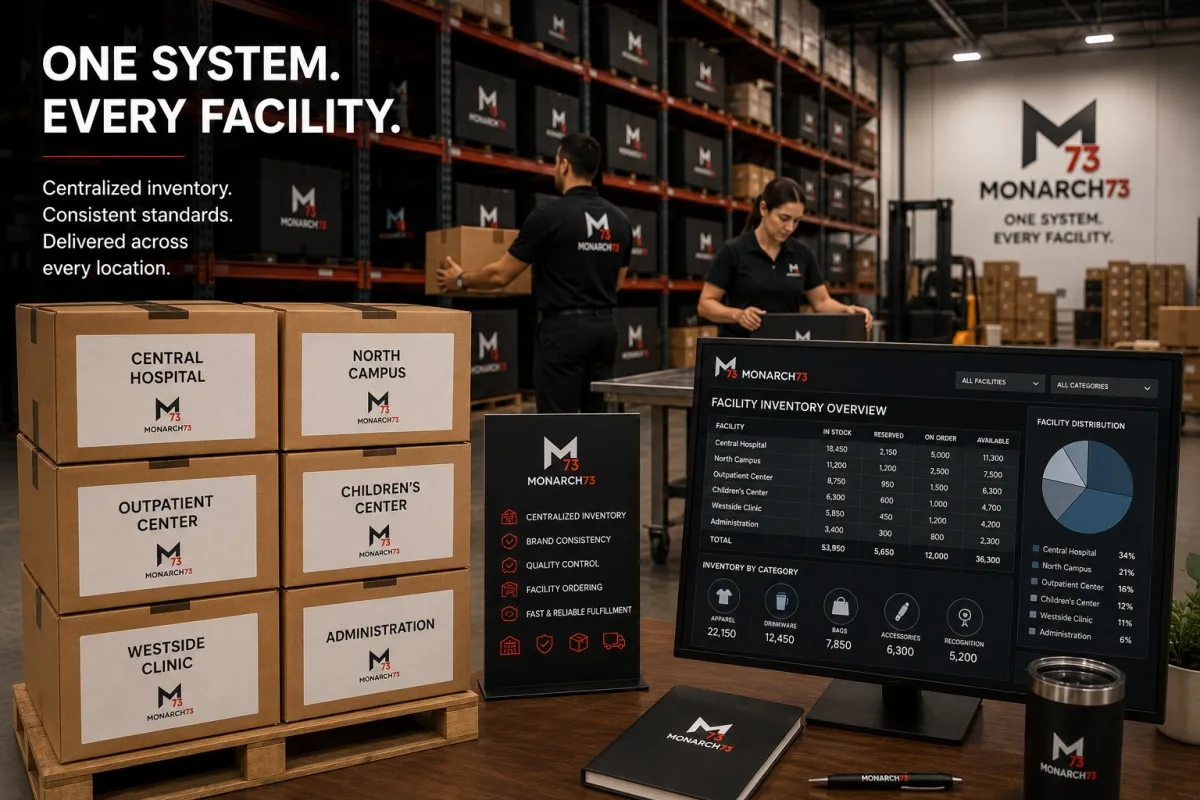
Ask a health system who buys merchandise and the honest answer is: most people, occasionally. The main hospital orders staff apparel. The outpatient center orders its own. HR runs recognition, marketing runs community events, and each clinic solves its own problem when it arises.
None of that is mismanagement. It is what happens when merchandise is a small part of several people's jobs and no part of anyone's.
Centralise the catalog, not the ordering
The instinct is to route every request through one desk. It fails, because the desk becomes a bottleneck and facilities go around it the first time somebody is on leave.
Separate the two decisions. What is approved is decided once, centrally. Who can order it is a separate question, and the answer should be: the people who need it, without asking again.
Produce once, release over the year
Facilities do not need everything at once, but they do need the same thing all year. Producing at system volume and holding the stock is what makes both possible — the unit price of a single large run, released one order at a time.
It also fixes the consistency problem, because the fleece a nurse receives in November came from the same run as the one issued in March.
Expect facilities to want their own name
A system standard and a facility identity are not in conflict, and treating them as such is how these programs lose the people meant to use them. The same product can carry the system mark, a campus name, or both, decorated per facility inside one production run.
Track it by facility or do not track it
If orders are not associated with the facility or department that placed them, the program cannot be reported on and therefore cannot be defended at budget time. That association is easy to build in at the start and impossible to reconstruct afterwards.
We run merchandise programs for health systems, and warehousing covers holding system inventory and releasing it facility by facility.