
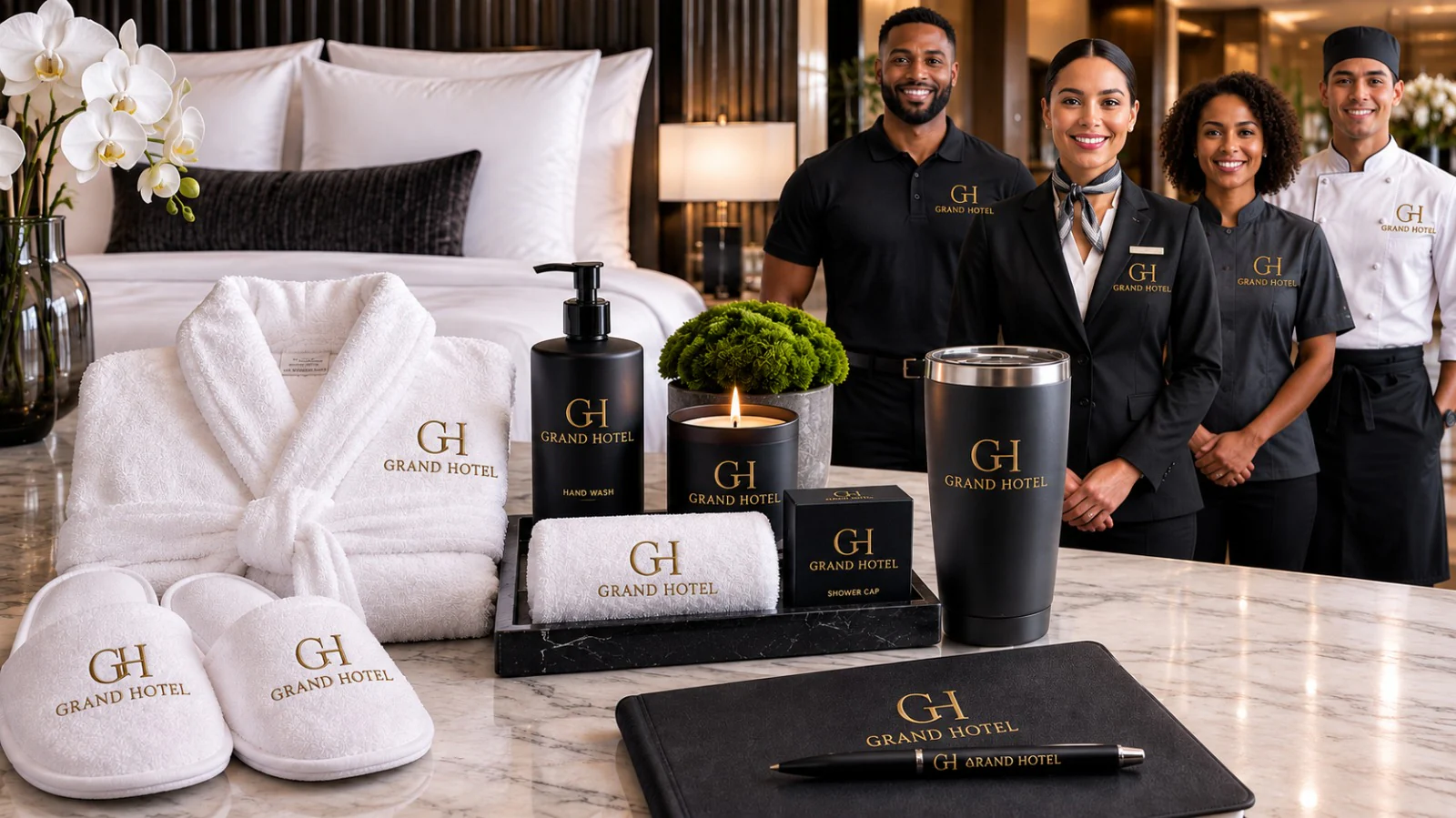
In-room amenities and staff apparel are usually bought by the same person under the same budget line, and they are almost nothing alike as purchases. One is judged on how it looks and feels for thirty seconds. The other has to survive two hundred wash cycles and still look deliberate on a twelve-hour shift.
Amenities: the object is the message
Anything in the room is read as a statement about the room. A guest cannot inspect your supply chain, so they infer the quality of the property from the weight of the tumbler and the finish on the signage.
Three things matter more than the item choice.
Finish over feature. A plain, well-made object beats a clever one with a bad edge. Guests notice moulding seams and rubbed print before they notice functionality.
Restraint with branding. The mark should be findable, not announced. A discreet logo reads as a hotel that is confident; a large one reads as merchandise.
Replaceability. In-room items are stolen, and the good ones are stolen most. Treat that as a compliment and a budget line, and never specify an amenity you cannot reorder easily.
Apparel: the garment has to work for a shift
Staff apparel fails on wear, not on design. The common mistakes are consistent.
Buying to a photograph. A polo that looks right on a model is not a polo that looks right at hour ten. Ask for the fabric weight, and get a physical sample on an actual employee before committing.
Ignoring the wash. Hospitality laundries are aggressive. A garment that fades after twenty industrial washes will be replaced twice as often as a slightly more expensive one that does not — the cheaper shirt is usually the more expensive decision.
One cut for everyone. Different body shapes and different roles need different garments. The most common cause of staff not wearing the uniform properly is that it does not fit them properly.
Decoration method. Embroidery survives industrial laundering far better than print, and it is what separates a uniform that still looks intentional in month eight from one that looks worn out.
What they share
Both are continuous, not one-off. New staff arrive, amenities are consumed, and stock is the difference between a program and a scramble. Both benefit from a specification held centrally so the second order matches the first.
We supply amenities and uniforms to hotels and resorts as one program, so the room and the people in it are held to the same standard. Uniform programs specifically are covered under employee apparel and swag.