
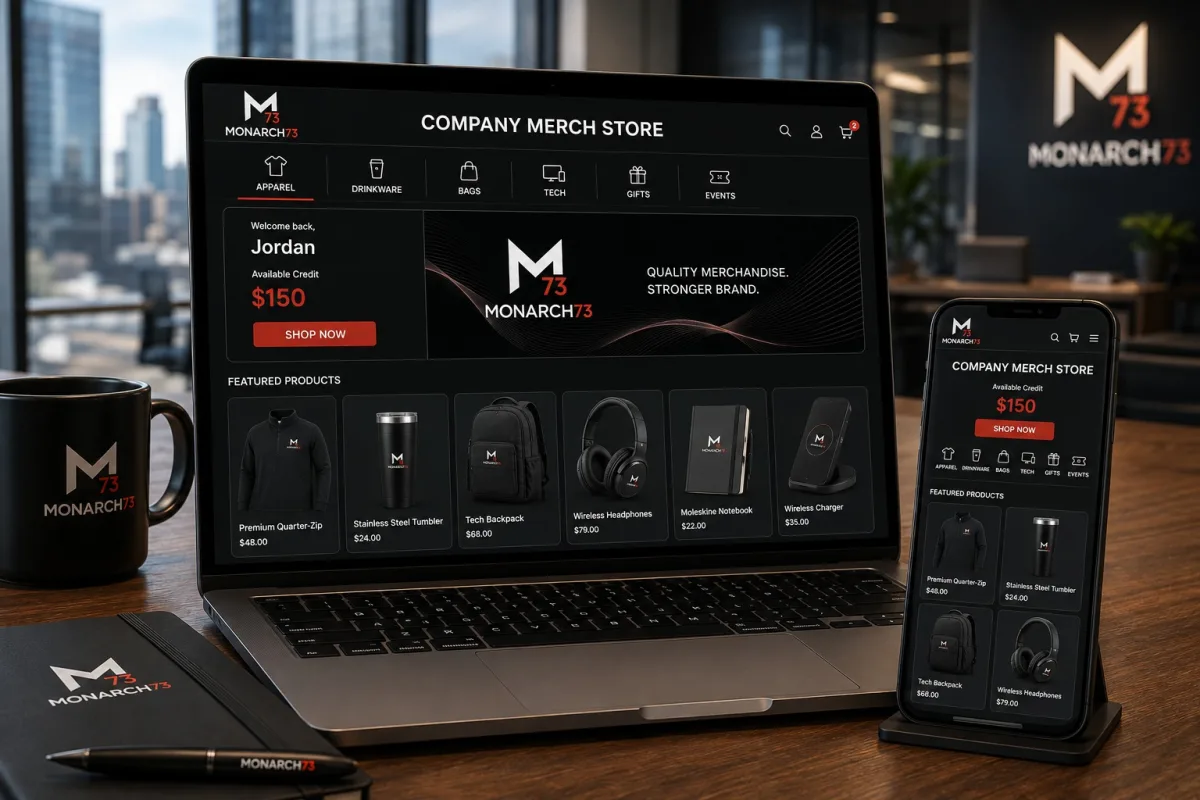
The question is usually framed as a choice. In practice a store sits on top of bulk ordering rather than replacing it: you still produce in bulk, you just change who releases it and when.
What actually differs is who does the work and when the money is spent.
Bulk ordering: cheapest per unit, most work per order
One decision, one production run, the best unit price, one delivery. The costs are elsewhere — somebody has to decide what everyone gets, collect sizes, store the boxes and distribute them. That somebody is usually a person with another full-time job, and the cartons usually live in an office corner.
It suits a defined moment: an event, a launch, a single all-hands.
A store: more infrastructure, far less coordination
Employees or locations order what they need, when they need it, from a range you approved. Nobody collects sizes. Nobody stores boxes. Spend moves from a large annual commitment to a running cost, and orders can be reported by department.
It suits continuous demand: onboarding, replacement, multiple locations, distributed teams.
The economics are not opposed
The store is not an alternative to buying in volume — the stock behind it is still produced in bulk. What changes is that the volume is bought once and released over time, so you get the unit price without taking delivery of everything at once.
Which one first
If merchandise is ordered once or twice a year by one person, bulk ordering is fine and a store is overhead. If more than one team orders, or people are in more than one place, or hiring is continuous, the coordination cost is already being paid — just invisibly, by whoever is doing it.
The honest failure mode of a store
A store with a thin range and nothing in stock is worse than an email. It needs a real catalog and held inventory behind it, and if the program cannot support that yet, bulk ordering is the right answer for now.
Branded eStores covers the store side and bulk merchandise the production behind it.